

For me, stress is a huge factor in my MS journey. In fact, I am convinced that my first episode of MS was brought on and accelerated entirely by stress. It was the run-up to Christmas. My son had just started school, and our calendar was filled with a thousand and one things to remember. Our home life was no different with all the countless social gatherings (why do we ALL have to make another date before Christmas??).
But I also had a ridiculous workload, working essentially two jobs; my full-time day job and my hobby editorial website for local mums, for which I decided to run a special advent feature throughout December. I never counted, but I must have spent some 60+ hours per week on my laptop. When I eventually closed the lid on said laptop just days before Christmas, MS reared its ugly head for the first time, and my journey with Multiple Sclerosis began. I know stress wasn’t the cause, but I strongly believe it was the reason why my first episode was the most severe of all my relapses.
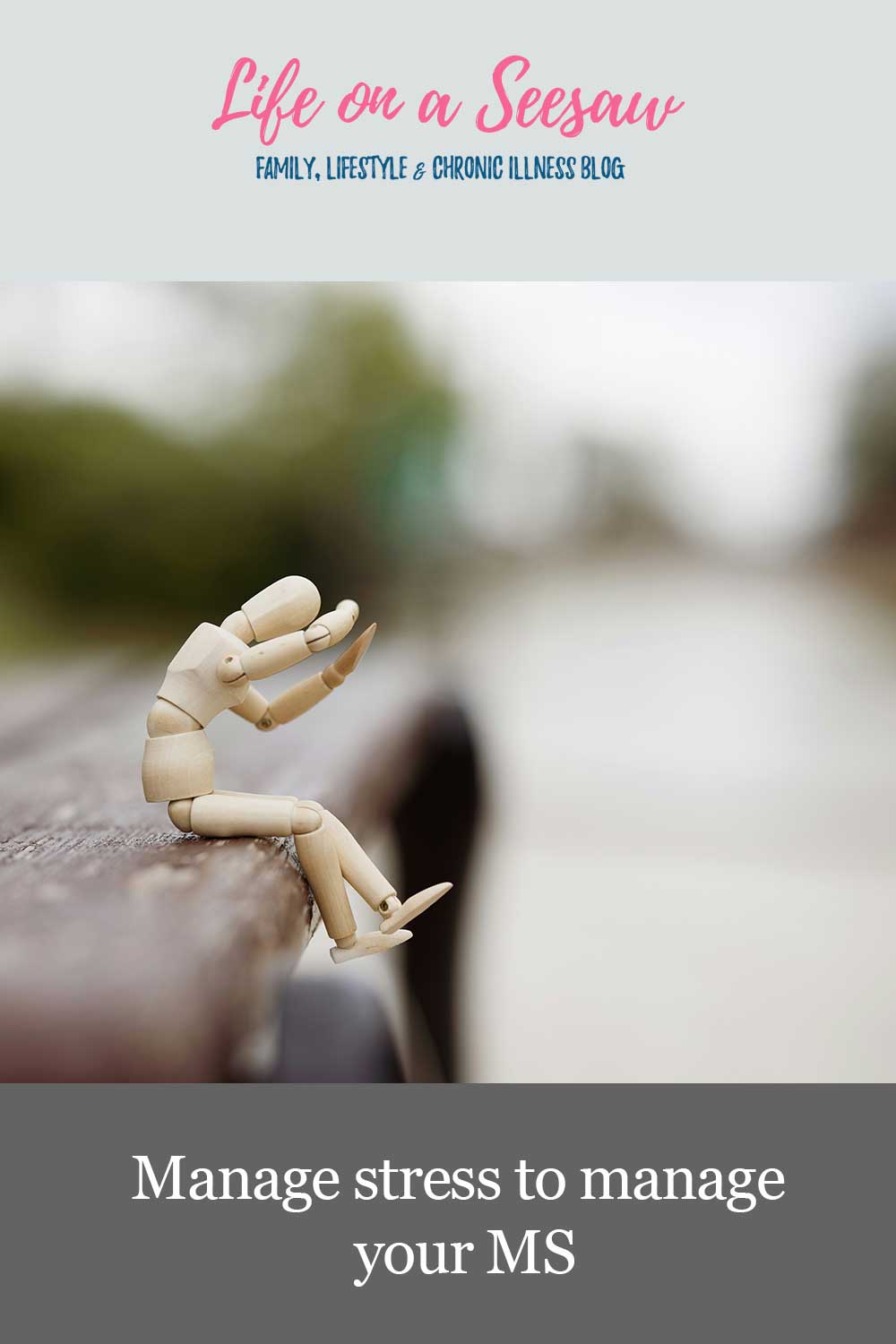
My neurologist explained that stress doesn’t directly cause MS, but it can certainly trigger symptoms and worsen existing ones. The body’s stress response releases hormones like cortisol and adrenaline, which can affect inflammation and immune function. Looking back, I can see how I was pushing my body beyond its limits, ignoring all the warning signs of exhaustion that were flashing like neon signs in front of me. So, how the heck do you manage stress to the point of actually making a difference?
Stress is a part of life
The reality is that our lives have changed. Technology has gotten us to a point where we are constantly present and are expected to react immediately. We don’t wait for a letter in the post anymore, a quickly typed message has replaced meeting up in person, we expect to have the answer to a question at the snap of a finger. Adding to this, the mother of today is expected to have it all: a successful career, happy and thriving children and a loving marriage with a dedicated and supporting husband. I’m not sure about you, but I often end up feeling like I’m doing none of those things properly because I’m simply spreading myself too thin!
The constant bombardment of information from social media doesn’t help either, with perfectly curated feeds showing us how everyone else seems to be managing better than us. And for those of us with MS, there’s an additional layer of pressure – the invisible symptoms that others can’t see but that we feel acutely. The fatigue that hits like a ton of bricks, the brain fog that makes simple tasks feel impossible, all while trying to maintain the appearance that everything is normal.
I have learned how to make daily life a little more chilled. A few things I have picked up along the way to help manage stress have become fixed parts of my daily routine. If anything sounds a bit “hocus pocus” to you, I invite you to be open to experiment and just see where the journey might take you. Give it a try! Remember, what works for one person might not work for another, and that’s perfectly fine. It’s about finding your own toolkit of techniques that help you manage your particular stress triggers.
Meditation
This is at the top of my list because it’s a biggy for me. I know what you’re thinking, but it doesn’t have to be the classic cross-legged pose with your thumb and index finger touching and a teacher at the front of a meditation class chanting some weird stuff and you going into a strange trance-like state.
The advice given to me was to simply sit up comfortably straight, with my hands in my lap and concentrate on breathing. It can be quite a challenge, and some days are easier than others, but that’s not important. Distracting thoughts are simply acknowledged and moved on like little puffy clouds. You can go to meditation classes, find loads of apps for your phone or videos on YouTube that will guide you.
When I first started, I could barely sit still for two minutes without my mind racing to my to-do list. But I stuck with it, and gradually built up my practice. There’s actual science behind this, too – studies have shown that regular meditation can reduce inflammation markers in the blood and help regulate the immune system, both of which are particularly relevant for those of us with MS.
Just ten minutes of meditation every morning has helped me hugely with managing fatigue and starting the day afresh. On days when symptoms are particularly challenging, I sometimes do a second short meditation after lunch, which helps reset my energy levels for the afternoon. It’s like giving your brain a mini-holiday in the midst of chaos.
Practising Gratitude
At first, I found this really difficult. But like the meditation in the morning, it has become a regular ritual I do regularly. Most evenings, I try to write about three things I am grateful for. It’s not always easy, especially during times when things are tough. We all know how hard MS can be on our mental well-being. When going through a relapse, for example, it can be hard to find the good in a day. But this is exactly why this exercise is so helpful. It helps me focus on the good things that happened, however tiny.
The practice has completely shifted my mindset over time. Instead of going through my day focusing on limitations, I find myself mentally noting moments of joy to add to my gratitude list later. It’s like training your brain to spot the positive, even when it feels like it’s hiding.
As a mum with MS, often my list includes seemingly small things like not getting too tired on a visit to the playground or movie snuggles with my son on a day I don’t feel up to heading outside. Sometimes those things are materialistic like buying a new jumper, but that’s ok as long as you focus on the feeling of that new jumper: how its softness is making you feel, how it made you feel to treat yourself to something new. You’ll be surprised at how helpful this exercise can be. I’ve noticed that on days when I skip my gratitude practice, I’m more likely to fall into negative thought patterns the next day. It’s become as essential to my well-being as taking my medications.
Mindfulness
What actually is mindfulness? To be mindful means to do something and devote your full attention to it. People love to draw or colour-in, knit or get lost in a good book.
Mindfulness is about being fully present in the moment, without judgment or distraction. Mindfulness helps us tune into our bodies without getting caught up in anxiety about symptoms. It’s the difference between thinking “I’ m so tired, I’m always tired, this is terrible, will I ever feel normal again?” and simply noting “There’s fatigue in my body right now” and responding compassionately to that need.
I have had times in the past when I’ve been so busy at work I literally did not know what to do first. I joke about it now, but I often got to a point where I simply got up and removed myself completely by doing something ridiculously unimportant, like photocopying some forms or doing some filing. These things were part of my workload, but the absolute bottom of my priorities. Just ten minutes helped me refuel and get my head into a calm and quiet mode again. I didn’t know it then, but I was practising mindfulness and then managed to approach my pile of top priorities with new vigour.
One of my favourite mindfulness practices now is water colouring. It’s a challenge without being too difficult to become frustrating. I get really into it and even get compliments on my results! Most importantly, it really helps me switch off for a while.
Gentle Movement
I’ve discovered that gentle movement is essential for managing both my stress levels and MS symptoms. Whether it’s a slow walk around the garden, some gentle stretching, or a beginner’s yoga session, moving my body mindfully makes a tremendous difference to how I feel.
On days when fatigue is high, I might just do five minutes of stretching. On better days, I enjoy a 20-minute yoga session. The key is consistency rather than intensity. I’ve learned to listen to my body’s signals rather than pushing through pain or exhaustion as I might have done before my diagnosis.
The mental benefits are just as important as the physical ones. I’ve found that even on my worst days, some form of gentle movement improves my mood greatly.
Setting Boundaries
Learning to set boundaries has been one of the most challenging but rewarding aspects of managing stress with MS. I’ve had to learn to say “no” without feeling guilty and to prioritise my health over others’ expectations.
This means sometimes turning down social invitations when I know I need rest, or asking for help with household tasks rather than pushing myself to breaking point. It also means having honest conversations with family, friends and colleagues about my limitations and needs. Most people are understanding when you explain clearly what you’re experiencing.
I’ve also set digital boundaries – specific times when I check emails and social media, rather than being constantly available. The world won’t end if I don’t respond to a message immediately! Creating these pockets of unavailability throughout my day has dramatically reduced my overall stress levels and given me space to recharge.
The Take Away: Be kind to yourself
Looking back, I’ve never done that Christmas feature again and instead I am focussing on being happy with just managing the most important things when life gets busy. With a crazy week looming, I review what I would ideally like to get done, and then I radically cut out what can wait and would add unnecessary stress. I often do this with pen and paper for the most effect.
The reality is that having MS means we need to be even more intentional about managing our energy reserves. I think of it like having a smaller battery than others – I need to be strategic about what I use that energy for. Once I accepted this rather than fighting against it, my quality of life improved dramatically. Some days, success might look like doing less but enjoying it more.
Starting to do this was a huge shift in the thought process of approaching life: be kind to yourself. Forgive yourself for not managing it all. Talk to your inner voice, the one that’s telling you to always be perfect, tell it that you refuse to listen, and you are looking after your body instead.
I’m still very much learning, and there are still areas that I get far too stressed out about, but I’m getting there, and I hope this helps you too. Remember that stress management isn’t a luxury for us – it’s essential medicine for our wellbeing. Finding what works for you might take time, but every small step toward a calmer life is progress worth celebrating.